
validateHE: validation of R-based health-economic models

Validate your model with us!

Free while in beta. Expanded model testing starts November 2026; we schedule models in the order requests arrive.

Illustration: the five validation types drawn as a forest plot, each with a point estimate inside its interval. Solid intervals have been used on production models; dashed intervals have so far been tested only on public tutorial models. TransparencyFace validityVerificationCross-validationExternal validationused on production modelstutorial models only

Why validateHE

Errors in health-economic models are common, and validation is rarely reported.

39 of 41
NICE single technology appraisals had at least one reported error in the company's model. [2]
Under 4%
of recent early breast cancer model evaluations report validating the computerised model. [3]
30%
of cancer decision models in a 2026 systematic review reported any validation. [4]

Expert review is scarce and slow. AI agents can read, run and test model code, yet a PubMed search in October 2026 found no peer-reviewed study of AI for validating health-economic models; studies of language models so far build or replicate models. [5, 6]

Human and AI validation might complement each other. People bring scoping, subject-matter knowledge, judgement and experience; agents may be stronger on code and detail.

A model can pass verification and still be wrong about the world.

What it checks

validateHE is an AI agent skill: instructions, checklists and base-R scripts that an AI coding agent follows. It runs in Claude Code and OpenAI Codex, and other agentic tools that support skills may be able to run it too.

It validates R-based health-economic models (cohort state-transition (Markov), decision tree, discrete event simulation, partitioned survival and individual-level microsimulation) and follows the five validation types of the ISPOR-SMDM Modeling Good Research Practices Task Force. [1]

Run order: the R model and its documentation are copied read-only. Transparency (M1) runs alongside the other modules. Verification (M3) runs first among the technical modules; cross-validation (M4) and external validation (M5) then run in parallel on its base case; the face-validity council (M2) reads all findings last; the result is an HTA-oriented report. InputsR model repository+ dossier or manuscriptRead-only scratch copyhash-verified before and afterM1 Transparencydocumentation review;CHEERS if manuscriptM3 Verificationblack-box and white-boxtests, coding standardsM4 Cross-validationvs comparator modelsM5 External validationvs observed dataM2 Face validitysix independent critiques,then an optional deliberationHTA-oriented reportverdict, evidence-cited findings,checklist scores, fix list
Run order. Transparency runs alongside everything. Cross-validation and external validation run in parallel once verification has a base case. The council runs last and reads every finding before judging plausibility. Dashed boxes have so far been tested only on public tutorial models.
  1. Transparency

    Is the model documented clearly enough to review?

    Documentation reviewers check the README, dossier and code comments for completeness and consistency, and score CHEERS 2022 when a manuscript is supplied.

    You bring: Your code and documentation; a manuscript or preprint adds CHEERS 2022.

    Tested on: production models
  2. Face validity

    Do the structure, inputs and outcomes look plausible?

    A simulated evidence review group: six AI reviewers with separate roles each write an independent critique, blind to the others; an optional deliberation round follows.

    You bring: Nothing beyond your code and documentation.

    Tested on: production models
  3. Verification

    Does the code do what the modelers intended, correctly?

    Black-box tests (including unit tests of each function), white-box review with root-cause tracing, and a coding-standards review.

    You bring: Nothing beyond your code and documentation.

    Tested on: production models (partitioned survival, decision tree); tutorial models only (Markov, DES, microsimulation)
  4. Cross-validation

    Do other models of the same decision problem reach compatible answers?

    Compares results with a supplied comparator model or published results: corroboration, not proof.

    You bring: A comparator model of the same decision problem, or its published results.

    Tested on: public tutorial models only
  5. External validation

    Does the model reproduce what actually happened?

    Compares predictions with supplied observed data, such as life tables, registries or trial data.

    You bring: Observed data, as an aggregated table (no patient-level data).

    Tested on: public tutorial models only

Findings are mapped item by item to four published checklists (CDA-AMC, TECH-VER, AdViSHE and CHAOS), plus CHEERS 2022 when the documentation includes a manuscript. Every verdict cites the test it rests on. [8, 9, 10, 11, 12]

Where it has been tested: transparency, face validity and the verification of partitioned survival and decision-tree models have been used on production models (the first results below). The verification of Markov, DES and microsimulation models, cross-validation and external validation have so far been tested only on public tutorial models.

Which module scores which checklist

ChecklistM1 transparencyM2 face validityM3 verificationM4 cross-validationM5 external validation
CDA-AMC Model Validation ToolHTA model-validation checklist, 53 itemsScored by M1 transparencyScored by M2 face validityScored by M3 verificationScored by M4 cross-validationScored by M5 external validation
TECH-VERVerification checklist in five stagesNot scored by M1 transparencyScored by M2 face validityScored by M3 verificationScored by M4 cross-validationScored by M5 external validation
AdViSHEValidation-assessment tool, parts A to EScored by M1 transparencyScored by M2 face validityScored by M3 verificationScored by M4 cross-validationScored by M5 external validation
CHAOS (draft)Checklist for open-source modelsScored by M1 transparencyNot scored by M2 face validityScored by M3 verificationNot scored by M4 cross-validationNot scored by M5 external validation
CHEERS 2022Reporting standard, 28 itemsScored by M1 transparency only when a manuscript is suppliedNot scored by M2 face validityNot scored by M3 verificationNot scored by M4 cross-validationNot scored by M5 external validation

Scores items. Only when a manuscript or preprint is supplied. M1 transparency, M2 face validity, M3 verification, M4 cross-validation, M5 external validation. Items owned by a module that was not run are reported as Deferred; Excel-specific CDA-AMC items are scored through their R equivalents.

The face-validity council

Module 2 simulates an HTA evidence review group: six AI reviewers with deliberately separate roles judge whether the model's structure, inputs and outcomes are plausible.

The face-validity council: six AI reviewers (clinician, technical modeler, health economist, HTA assessor, patient representative and payer) seated around your model. Each reads every other member's opinion during deliberation. your modelClinicianTechnicalmodelerHealtheconomistHTA assessorPatientrepresentativePayer
  1. Independent critiques

    Each member reviews an evidence packet built from the documentation, the code inventory, inputs and outputs, and writes a structured critique, blind to the others: what fits its practice, what raises concern, and what it would need before signing off.

  2. Deliberation (optional)

    The members then read each other's critiques, respond, and converge or record dissent. Whether this round adds value beyond the independent critiques is still being tested. The council runs last, so it also reads the verification, cross-validation and external-validation findings.

  3. Minutes in the report

    The consensus view, dissent named by role and open questions for the authors go into the report, with recommended fixes that are not applied.

  • Clinician

    Disease pathway, clinical events, mortality, health outcomes and treatment pathway.

  • Technical modeler

    Model type, state and event structure, cycle length, extrapolation and structural assumptions; reads the technical findings.

  • Health economist

    Whether the economics is correct: perspective, discounting, costs, QALYs and incremental analysis.

  • HTA assessor

    Whether an appraisal body would accept it: reference case, comparators, evidence standards and uncertainty, for a named jurisdiction.

  • Patient representative

    Patient-important outcomes, adverse events, treatment burden and quality of life.

  • Payer

    Affordability, budget impact, resource use and implementation.

The council is AI-simulated, not a panel of human experts, and the report says so. Checklist items that ask whether human experts were consulted stay capped unless your materials document a real human expert review.

First results

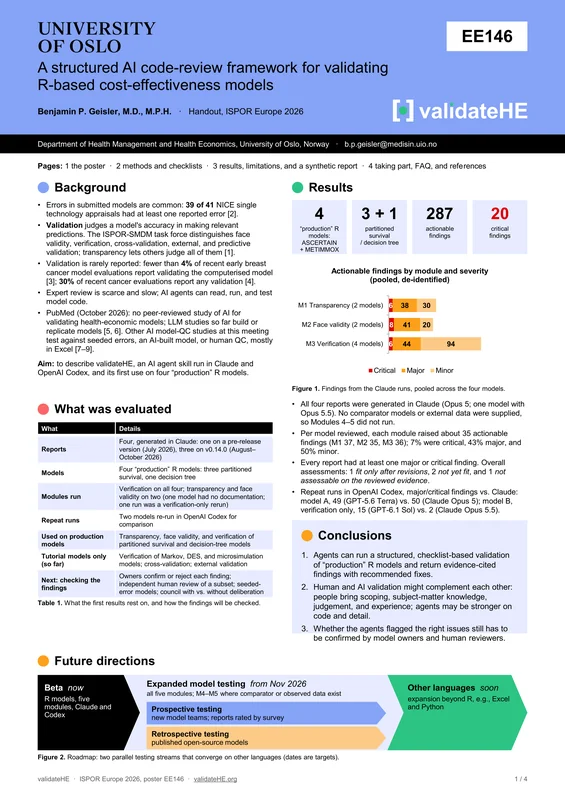
The first use on four "production" R models (three partitioned survival models and one decision tree) returned 287 actionable findings, 20 of them critical.

Actionable findings by module and severity, pooled across the four models (de-identified)
ModuleCriticalMajorMinor
M1 Transparency 2 models, 37 findings per model63830
M2 Face validity 2 models, 35 findings per model84120
M3 Verification 4 models, 36 findings per model64494
Total207% of all12343% of all14450% of all
Bars share one scale. Reports generated with Claude. Verification ran on all four models, transparency and face validity on two: one model had no documentation to review, and one run was a verification-only rerun. Cross-validation and external validation did not run: no comparator models or observed data were supplied.
  • Every report had at least one major or critical finding.
  • Per model reviewed, each module raised about 35 findings: transparency 37, face validity 35, verification 36.
  • Overall assessments: one fit only after revisions, two not yet fit, and one not assessable on the reviewed evidence.

What it does and does not do

  • AI-assisted review. All modules use AI reviewers, and the report states that scope explicitly.
  • Evidence for every finding. Every finding cites the test it rests on and its file and line, and the report states what it could not test in that run, and why.
  • A simulated council, not human experts. The face-validity council is AI-simulated: six reviewer lenses (clinician, technical modeler, health economist, HTA assessor, patient representative, payer) write independent critiques, followed by an optional deliberation round. Checklist items that ask whether human experts were consulted are capped unless your materials document a real human expert review.
  • Read-only on your model. validateHE never edits the model it reviews: it works on a temporary copy and verifies by before/after content hash that the original is unchanged.
  • Fixes recommended, never applied. Findings come with recommended fixes in a report appendix; none of them are applied.
  • Missing evidence is reported, not invented. Comparator and observed values are never filled in from general knowledge: without supplied evidence, cross-validation and external validation are reported as not assessable.
  • R models only, for now. validateHE validates models written in R.

Two ways to take part

We run it for you.

Share a current project to find bugs before reviewers do, or an older model with its documentation just to try validateHE.

You run it yourself.

We share the skill with all its materials (e.g., checklists) via GitHub or e-mail.

Running it yourself needs R, Quarto and an AI coding agent such as Claude Code or OpenAI Codex.

You get a full report with evidence-cited findings and recommended fixes; in return, a short evaluation survey.

R models now; Excel and other languages soon.

A synthetic example report is available below.

Request a beta spot

See an example first

A synthetic example report

How a validateHE report is laid out: a short non-technical executive summary, a technical body with the evidence behind each finding, and an appendix of recommended changes that were not applied.

The example is fully invented. It describes no real model and no real result.
Open the example report

ISPOR Europe 2026 handout, accompanying poster EE146

A structured AI code-review framework for validating R-based cost-effectiveness models

Methods and checklist coverage, first results on four "production" R models, limitations, a synthetic report excerpt, FAQ and references. Prepared for the conference in the University of Oslo poster format.

Download the handout (PDF, 4 pages, 1 MB)

What every report contains

  1. 1. Executive summaryPlain-language verdict, the five methods at a glance, top findings, the council's view, checklists
  2. 2. Technical bodyScope and environment, methods, results by module (M1 to M5), coding standards, completed checklists
  3. Appendices A to CRecommended fixes and points for clarification, function inventory and dependency map, council minutes

How your material is handled

We are still developing our processes for the full range of projects, from open-source models of academic projects to confidential and sensitive models of commercial organizations. During the beta, it works like this.

If we run it for you

  • You send your model and documentation by a secure transfer method we agree with you. Please do not send personal or patient-level data.
  • We are happy to sign your confidentiality agreement before you share anything; Benjamin P. Geisler signs it personally.
  • validateHE runs on our computer in an AI coding tool, Claude Code (Anthropic) or Codex (OpenAI). The provider processes your code and documentation to produce the review; we do not allow it to use your material for model training. Before you send anything, we confirm the provider's terms (training, retention and data region) in writing.
  • validateHE works on a temporary copy and never changes your model.
  • We delete your model and documentation 90 days after we deliver the report, or earlier if you ask. We keep the report unless you object; on request we delete everything, including the report.
  • In return, we ask you to fill in a short evaluation survey.

If you run it yourself

  • We share the skill, free during the beta, and help you run it at your site, in person or remotely.
  • We take no copies of your model, documentation or report.
  • validateHE runs in your own AI coding agent, such as Claude Code or OpenAI Codex, so your own agreement with that provider applies.
  • In return, we ask you to fill in a short evaluation survey.

Research use of the beta

  • Evaluation survey answers may be reported in aggregated, anonymised form, for example in conference abstracts and papers.
  • Nothing from your model, documentation or report is published or shown to others without your written permission.
  • With your permission, findings may be rewritten into de-identified example reports.

Questions about any of this are welcome: .

What comes next

  1. Now

    Beta

    R models, five validation modules, Claude Code and OpenAI Codex.

  2. From November 2026

    Expanded model testing

    All five modules, with cross- and external validation where comparator or observed data exist. Prospective testing with new model teams, reports rated by survey; retrospective testing on published open-source models.

  3. Soon

    Other languages

    Beyond R, for example Excel and Python.

How the findings will be checked

Model owners confirm or reject each finding and its grading. Independent human reviewers review a subset of the same models, so their findings can be compared with the agents'. Models with deliberately planted errors show what the agents catch and miss. The council is compared with and without its deliberation round.

Dates are targets.

Who is behind validateHE

validateHE is built by Benjamin P. Geisler, M.D., M.P.H., at the Department of Health Management and Health Economics, University of Oslo.

It was presented at ISPOR Europe 2026 as poster EE146; the handout describes the methods and first results. Questions and ideas are welcome: .

Funding
University of Oslo operating funds
Conflicts of interest
None
AI agents used
Claude Code (Anthropic) and Codex (OpenAI)

Frequently asked questions

What is black-box testing?

The model is run and its outputs are tested without reading the code, against expectations set before the run. Examples: with every utility set to 1, QALYs must equal life-years; with all costs set to 0, no costs may accumulate; with the discount rate at 0, discounted and undiscounted results must match; swapping two strategies' inputs must swap their results; the cohort must be conserved in every cycle; and the base case must give identical results when run twice. It also writes and runs unit tests for each function on the path from inputs to results.

What is white-box testing?

The critical calculations are read line by line: transition-matrix construction, discount timing and rate, time-unit conversions, survival-parameter extraction, cost and utility structuring, and half-cycle correction. Results are traced back to their inputs and inputs forward to results, and the root cause of each black-box failure is traced through a map of which function calls which.

What does the coding-standards review check?

Consistency first, and patterns that make a model hard to audit or hide its failures: hidden global variables, duplicated definitions that drift apart, and silently swallowed errors are graded above style issues. It also checks documentation, modularity and reproducibility: whether a lockfile exists and whether the base case runs and replicates. Style is judged against a configurable profile: by default the tidyverse style guide with DARTH naming, or your team's own conventions.

Which AI agents can run it?

Claude Code and OpenAI Codex. validateHE is packaged as a standard skill folder, so other agentic coding tools that support skills may be able to run it as well; those are untested.

Does validateHE change my model?

No. It works on a temporary copy, checks by before/after content hash that the original is unchanged, and never applies fixes; they are listed in the report as recommendations.

Which models can it validate?

Models written in R: cohort Markov, decision tree, partitioned survival, discrete event simulation and microsimulation. Excel and other languages are planned.

Is the face-validity council a panel of human experts?

No. It is AI-simulated, and the report says so. Checklist items that ask for human expert review stay capped unless your materials document one.

Does it replace human review?

No. It is a review aid: every finding cites its test and file location so a person can check it, and the report states what it could not test in that run, and why.

What if I have no comparator model or observed data?

Then cross-validation and external validation are reported as not assessable. Values are never filled in from general knowledge.

Which checklists does it score?

The CDA-AMC Model Validation Tool, TECH-VER, AdViSHE and CHAOS, plus CHEERS 2022 when the documentation includes a manuscript or preprint. Items owned by a module that was not run are reported as Deferred. The checklists are listed under Sources.

What do I get back?

A report in HTML and PDF: a plain-language executive summary, a technical body with the evidence behind each finding, and appendices with the recommended fixes, a function inventory and dependency map, and the council minutes.

What does it cost?

Nothing during the beta. In return, we ask for a short evaluation survey.

How long does a run take?

A full run takes a couple of hours of agent time. If we run it for you, we agree a turnaround with you.

What happens after the beta?

The beta is an academic evaluation at the University of Oslo, and its results will be published. What follows the beta is not yet decided.

How are beta participants credited?

Participants are acknowledged in the evaluation paper. Those who contribute substantively, for example by confirming and grading findings, can be co-authors under the ICMJE criteria. Your model becomes a case study only with your written permission.

Can I see an example first?

Yes. There is a fully synthetic example report, and the ISPOR Europe 2026 handout shows methods and first results.

Request a spot in the free beta

Tell us a little about yourself and your model. Prefer e-mail? Write to .

Request a spot in the validateHE beta

Sources

Validation framework

  1. Eddy DM, Hollingworth W, Caro JJ, et al. Model transparency and validation: a report of the ISPOR-SMDM Modeling Good Research Practices Task Force-7. Value Health. 2012. PubMed 22999134

Evidence on errors and validation

  1. Radeva D, et al. Assessment of technical errors and validation processes in economic models submitted by the company for NICE technology appraisals. Int J Technol Assess Health Care. 2020. PubMed 32618536
  2. Abraham K, et al. Under-reporting of validation efforts for health economic models persists despite the availability of validation tools: a systematic review. PharmacoEconomics. 2025. PubMed 40293688
  3. Li P, et al. A systematic review of reporting of validation efforts for cancer health economic decision models. PharmacoEconomics. 2026. PubMed 42745154

AI in health-economic modelling

  1. Imre A, et al. From general-purpose models to purpose-built artificial intelligence systems for health economic modeling. Expert Rev Pharmacoecon Outcomes Res. 2026. PubMed 42605534
  2. Reason T, et al. Artificial intelligence to automate health economic modelling: a case study to evaluate the potential application of large language models. PharmacoEconomics Open. 2024. PubMed 38340276
  3. Fleurence RL, et al. ELEVATE-GenAI: reporting guidelines for the use of large language models in health economics and outcomes research. Value Health. 2025. PubMed 40653157

Checklists validateHE scores against

  1. CDA-AMC (formerly CADTH). Model Validation Tool for Economic Evaluations. Can J Health Technol. 2024. doi:10.51731/cjht.2024.862
  2. Büyükkaramikli NC, Rutten-van Mölken MPMH, Severens JL, Al M. TECH-VER: a verification checklist to reduce errors in models and improve their credibility. PharmacoEconomics. 2019;37:1391–1408. doi:10.1007/s40273-019-00844-y
  3. Vemer P, Corro Ramos I, van Voorn GAK, Al MJ, Feenstra TL. AdViSHE: a validation-assessment tool of health-economic models for decision makers and model users. PharmacoEconomics. 2016;34:349–361. doi:10.1007/s40273-015-0327-2
  4. CHAOS: CHecklist for Assessing Open Source models for health-economic evaluation, v0.9 (draft). 2026. Open-source model group
  5. Husereau D, et al. Consolidated Health Economic Evaluation Reporting Standards 2022 (CHEERS 2022) statement. BMJ. 2022;376:e067975. doi:10.1136/bmj-2021-067975